What a Concrete Driveway Costs in Palm Beach County: Our Range
Our range for a plain broom-finish pour is $7 to $13 per sq ft, and a typical two-car job of 500 to 700 sq ft at 4 to 5 inches lands between $3,500 and $9,100. Stamped and decorative work runs $12 to $20 per sq ft. Removing an old slab first adds $2 to $4 per sq ft. Those are our ranges, and each is confirmed in a free written estimate after we see the site, because a quote built over the phone is a guess.
Here is what sits inside that spread: the area you pour, the thickness, the ground, the edge of the road, the paperwork and the finish. Think of it as the long version of what our driveway page summarizes, and it uses numbers published by the offices that regulate the work. We don't quote anyone else's prices here.
The Square Footage Math, With Worked Examples
Price follows area. Multiply the length by the width to get square feet, then apply the range. These examples all use $7 to $13 per sq ft for a plain broom finish.
| Pour | Size | Area | Range at $7 to $13 |
|---|---|---|---|
| Single-car | 12 by 20 ft | 240 sq ft | $1,680 to $3,120 |
| Small two-car | 20 by 25 ft | 500 sq ft | $3,500 to $6,500 |
| Standard two-car | 24 by 25 ft | 600 sq ft | $4,200 to $7,800 |
| Wide two-car with turnaround | 28 by 25 ft | 700 sq ft | $4,900 to $9,100 |
The typical-project range of $3,500 to $9,100 is just 500 sq ft at the low rate through 700 sq ft at the high rate. The items below decide where you land inside each row. A longer run to a back gate adds area at the same rate, and an extra foot of width along a 25 foot run is 25 sq ft, or $175 to $325. Every figure is confirmed in a free written estimate after we see the site.
Thickness and Volume: Four, Five or Six Inches of Pour
Thickness sets how much material goes into the forms. A 600 sq ft slab at 4 inches is 200 cubic feet, about 7.4 cubic yards. At 5 inches it's 250 cubic feet, about 9.3 cubic yards, and at 6 inches it's 300 cubic feet, about 11.1 cubic yards. So a thicker pour sits higher in the range even when the footprint stays the same.
Trade guidance puts a minimum of 4 inches for a driveway, with thickened edges of an inch or two and control joints no more than about 10 feet apart cut to a quarter of the thickness. Florida's residential code sets a floor of 3 1/2 inches for slab-on-ground floors inside a building, which is a different rule from the one for a driveway. Whatever thickness you pick, we put it in the quote as its own line, along with the base and the joint layout, so you can compare it against any other bid. See the trade overview of driveway installation for the same guidance in more detail.
Some thickness isn't our call. Several places in our service area write a minimum for the apron or the swale section into their codes, covered next.
Apron Rules by Town That Change the Spec and the Number
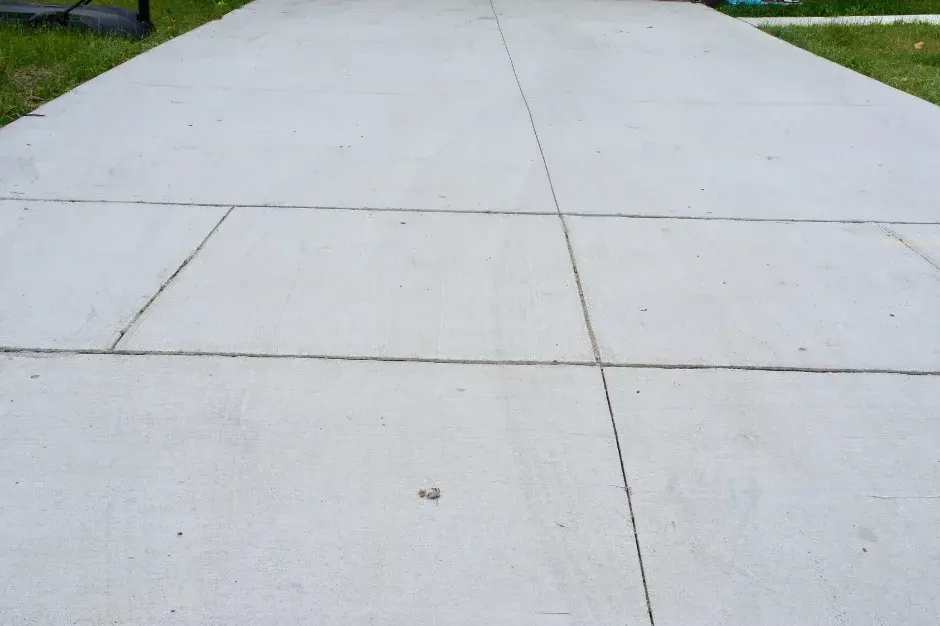
The strip between the street and your property line is where local rules bite. Wellington requires 6 inches of concrete at a minimum of 3000 PSI with no steel or wire mesh in the new drivable area of the apron. The Village of Royal Palm Beach requires the portion in the swale and the sidewalk crossing to be at least 6 inches thick, with a 1/2 inch preformed expansion joint on both sides of the crossing, and sets a two-car width of 20 feet. In The Acreage, the Indian Trail Improvement District's easement section is a minimum of 6 inches thick at 4,000 PSI over a minimum of 4 inches of compacted sand, with a 15 inch culvert unless the District decides otherwise.
Loxahatchee Groves puts a culvert at every connection. Lantana specifies 6 inch swale concrete with no steel, and Riviera Beach accepts 6 inches of concrete or 4 inches over mesh. Boynton Beach wants 6 inch concrete where the sidewalk crosses, and Westlake replaces the sidewalk under an apron extension with 6 inches. That's why a job can pair a 4 inch field with a 6 inch apron. The permit desk for each place is explained in the permit guide.
County Fees, Culverts and Turnouts: Charges That Sit Outside the Pour
Some charges go to a government office, not to the contractor, and they belong in the budget. On a County-maintained road, County Engineering's Land Development Division issues the right-of-way approval. Its fee schedule, updated October 29, 2025, lists a residential turnout at $275, with a separate charge of $35 per foot of culvert length where a culvert is used. A 20 foot culvert adds $700 in length charges on top of the turnout. Those are County figures, not our prices.
In The Acreage, ITID's published fees are a $250 initial layout and inspection charge, $125 for each re-inspection or additional layout, and $150 for a temporary driveway, and a permit expires 180 days after issuance with renewal at $125. ITID also caps total culvert length at 80 feet. Royal Palm Beach lists its residential right-of-way fee at $0.00 and a $75 minimum for a building permit, while Wellington's building permit has a $150 minimum. State roads add an FDOT connection fee that starts at $50 and rises with the traffic category. None of these is a reason to skip the paperwork: the County, Royal Palm Beach and Wellington each state four times the permit fee as the penalty for starting without one.
Culvert length, the number of connections and whether the road is County, city or state all come out in the site visit. See the County residential driveway sheet for the design rules behind the figures.
Tear-Out: Pricing the Old Slab Before the New One
Taking out an old slab is its own line at $2 to $4 per sq ft, and it's separate from the pour. On 600 sq ft that's $1,200 at the low rate and $2,400 at the high rate, in addition to the $4,200 to $7,800 for the new surface. Thickness, reinforcement and access decide where a job lands, and we see those on site. The removal gets its own line in the free written estimate.
Home age matters when a replacement starts with removal. The census survey puts the median home build year at about 1969 in Westgate, 1970 in Seminole Manor, 1972 in Pine Air and 1967 in San Castle, against about 1986 in Lake Belvedere Estates. Once the old pour is out, we look at the base. If it has settled, washed or been mixed with debris, rebuilding it is an added line, and we show that before you sign.
Wet Sand, Water Tables and the Base Under the Price
Ground decides how much work happens before any concrete arrives. Soil surveys describe Riviera fine sand, the unit under much of the western communities, as poorly drained with a seasonal water table that can rise to about 10 inches below the surface at its highest, for two to four months in most years. Myakka and Basinger sands near the center of the county have water tables that can rise to about a foot and about six inches at their highest. The coastal ridge sands under San Castle and parts of the east side are the opposite: excessively drained, with a water table that stays deeper than six feet even at its highest.
Wet ground doesn't change the price per square foot, but it can add base, fill or grading lines, and it changes how we pitch the pour so water leaves. Dry ridge sand asks less of the base. A site visit shows which kind you have, and the written estimate itemizes it. Our slab page covers the same ground conditions for buildings.
Stamped, Colored and Sealed: The $12 to $20 Tier
Pattern, color and sealer move the pour into a higher tier at $12 to $20 per sq ft. A 300 sq ft entry court is $3,600 to $6,000, a 400 sq ft stamped area is $4,800 to $8,000, and a 600 sq ft one is $7,200 to $12,000. The typical stamped project is $3,600 to $12,000 for 300 to 600 sq ft, and multi-pattern work runs toward the top. Each figure is confirmed in a free written estimate after we see the site.
Stamped surfaces need cleaning and resealing about every two to three years, according to the trade source we cite, and they can become slippery when wet or under a film-forming sealer. County rules bar decorative pavers and stamped concrete inside a road right-of-way without a recorded removal agreement, and ITID won't replace stamped work it removes from an easement. That's why a plain apron at the road with the stamping inside the property line works. The stamped concrete page shows the options, with the trade basics on stamped work for background.
Width, Shape and Extras That Add Square Feet
Width is where area sneaks in. The County allows 12 to 24 feet per connection and two connections on a local street, Royal Palm Beach sets 12 feet for one car and 20 for two, and Greenacres caps total driveway width at 30 feet with one driveway per house. West Palm Beach stops at 20 feet at the property line, Riviera Beach at 24 feet wide and 60 feet long, and Boynton Beach allows 10 to 24 feet. If your lot allows it, a second connection or a circular layout adds a full second run of concrete, which is a second row in the estimate.
Extras are measured the same way. A walk from the door to the street, a pad for trash cans, a widened turn or a parking pad beside the garage each adds square feet at the same range. Walks are priced at $8 to $14 per sq ft with a job minimum on short runs, and a pad beside the house is covered on the patio page. Bundle them into one visit and one pour, and the free written estimate stays honest about what each piece costs.
Permits, the Notice of Commencement and HOA Letters in the Budget
Three pieces of paper touch the price. First, the permit fee depends on your desk, and the permit guide explains who issues it. A Notice of Commencement is recorded when the direct contract price is more than $2,500, which a typical driveway job exceeds, and the owner signs it. A homeowners association may want its own approval before the permit, and Florida law limits an association to the authority in its declaration.
Only the permit fee and the recording cost money in the strict sense. The expensive mistake is starting without them, which costs four times the permit fee. A contractor who tells you small flatwork needs no permit is contradicting the County Building Official, whose memo says the state exemption for work under $7,500 does not apply in the county. Cities describe their own process, so ask your desk.
Reading a Written Estimate Line by Line
Two bids with the same total can describe different jobs. Compare them line by line.
- Area in square feet and the sketch it came from, not a round number.
- Thickness in inches, for the field and for the apron, and the strength where the local rule sets one.
- Base material and depth, and what happens if the base is soft.
- Reinforcement and joints: wire, fibers or neither, and the joint spacing.
- Removal of the old slab, by square foot, as a separate line.
- Apron, culvert and right-of-way items, and who pays the desk's fees.
- Finish: broom, stamped pattern, color and sealer.
- Who applies for the permit, who records the Notice of Commencement and who calls 811.
- Cure and protection: how long the pour stays closed to cars.
A bid that gives only a total, or one price per square foot with no thickness, isn't a bid you can compare, and a concrete driveway cost in Palm Beach County that hides these lines isn't worth trusting. Ours lists each one.
Cure Time, Closing Day and What the Pour Is Worth Protecting
Trade guidance says new concrete should cure at least a week before cars roll onto it, and that failing to cure right after final finishing can cut strength by up to half in extreme cases. We tell you the day it opens in the written quote and mark the edges.
Cure time also shapes your calendar. A recorded Notice of Commencement is void if work doesn't start in 90 days, and the permit may have its own clock, so book the pour near the paperwork, not months after it.
Get a Number for Your Own Lot
The concrete driveway cost in Palm Beach County comes down to area, thickness, ground, the road at your edge and the paperwork, in that order. Send your address, a rough size, a photo of the existing pad and the street edge, and a survey if you have one through the contact page. We measure, check the base and the apron rules for your town on the service area page, and send a detailed written quote before any work begins. Royal Palm Beach Concrete Co is Locally Owned & Operated, and the estimate is free.
Questions We Get
How much does a concrete driveway cost in Palm Beach County?
What is the cost per square foot for a new driveway here?
How much does it cost to replace an old driveway?
Does a stamped driveway cost much more than plain concrete?
Does thickness change the price?
Do permits and culverts add to the price?
Why do two contractors quote the same driveway so differently?
Is a driveway in Wellington priced differently from one in The Acreage?
When do I need a Notice of Commencement for a driveway?
Sources we used
- Residential Driveways, Palm Beach County Engineering & Public Works, Land Development Division
- Land Development Division Fees, Palm Beach County Engineering & Public Works
- Permits, Indian Trail Improvement District
- Florida Statutes 713.02 Types of lienors and exemptions, The Florida Legislature
- 2023 FBC-Residential Section R506 Concrete Floors (Slab-on-Ground), UpCodes / ICC Florida Building Code text
- Concrete Driveway Installation: 8 Essentials, Concrete Network
- Stamped Concrete Basics, Concrete Network
- Official Series Description: RIVIERA, USDA NRCS