
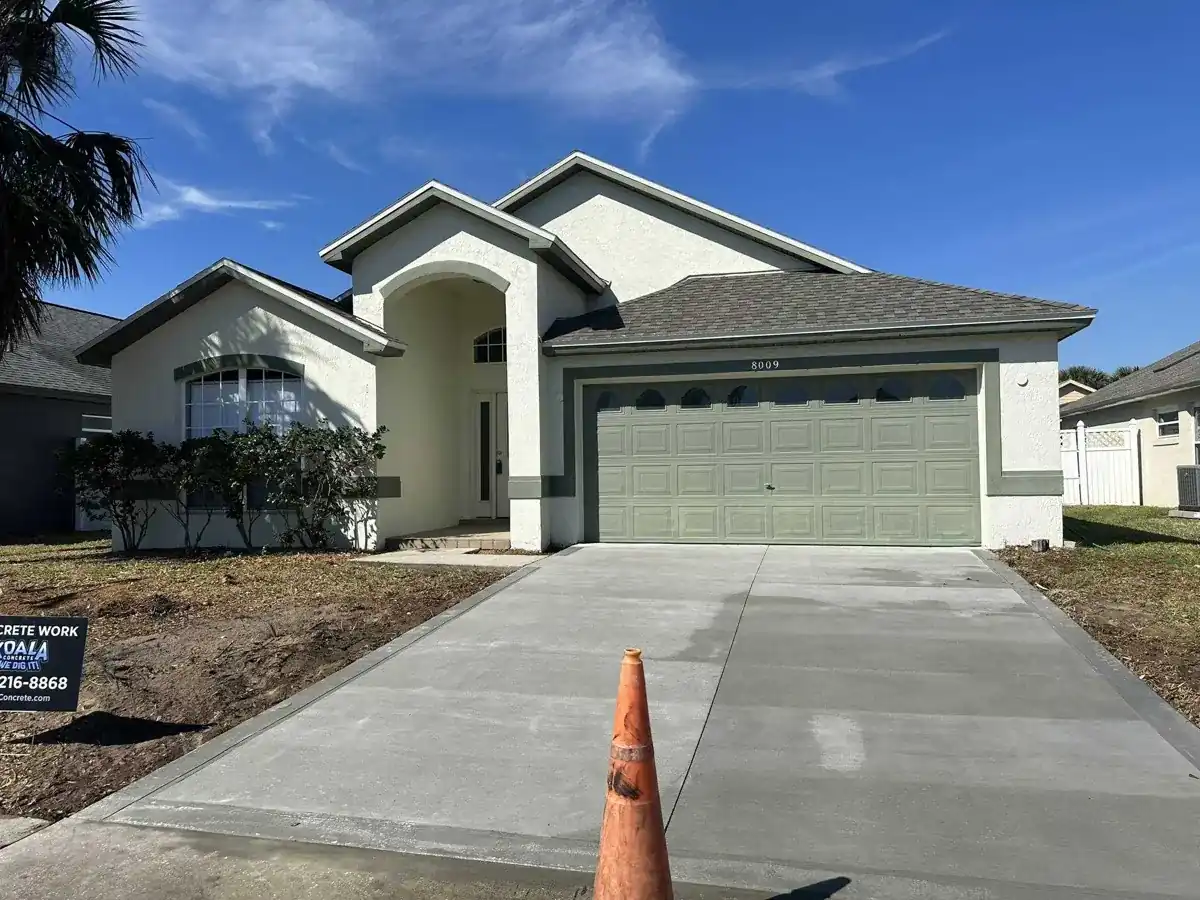
One Mailing Address, Two Different Rule Books
A long acreage driveway can fall under either of two governments, and the mailing address won't say which. Homes in The Acreage carry Loxahatchee postal addresses, and so do homes inside the separate Town of Loxahatchee Groves, which sits northwest of our Royal Palm Beach base. Each place has its own permit desk, its own culvert rules and its own way of inspecting the forms before concrete goes down.
The Acreage is unincorporated: Palm Beach County permits the building work and the Indian Trail Improvement District, called ITID here, permits every driveway and culvert. The Town of Loxahatchee Groves is incorporated and sets its own culvert minimum. A concrete driveway in The Acreage is a two-agency job, and in the Groves it is a Town job. Below are both rule sets, the culvert and slab specs, the inspection order and price math from our concrete driveway ranges.
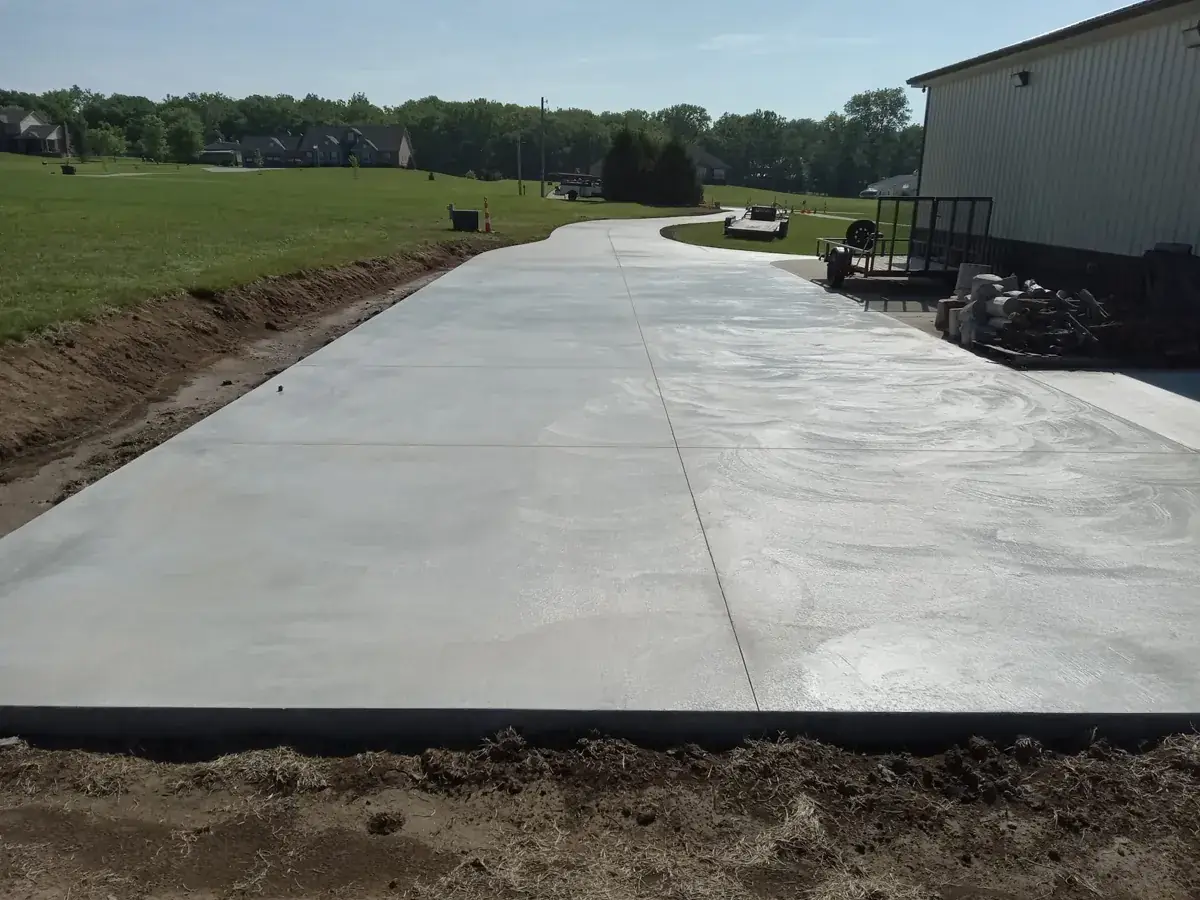
Permits for a Driveway in The Acreage: County Desk Plus ITID
Begin with the County. Palm Beach County's Permit Center takes applications for the unincorporated area through its ePZB online system, and The Acreage is a census-designated place with no city hall of its own. The County's "Permit Required?" brochure, dated 2014 and still posted by the Building Division, treats a driveway as a zoning-review permit only when it is resurfacing or repaving with no added paved area and no work in the right-of-way. A new driveway in The Acreage adds paved area, and the brochure is old, so ask the Permit Center what your parcel needs today.
The state's under-$7,500 exemption, HB 803, won't save a small job. The County's Building Official has said it doesn't apply anywhere in Palm Beach County because the whole county is a flood hazard area. Our county concrete permit guide covers the memo.
ITID is the second desk. Every driveway is permitted through the District, ITID staff inspect it once it is installed, and afterward the owner maintains the driveway and the culvert. A third desk joins in when the driveway meets a County-maintained road that needs a culvert, or a County thoroughfare. Then County Engineering's Land Development Division issues a right-of-way permit, with a residential turnout fee of $275, plus $35 per foot of culvert length where a culvert is used. County connections run 12 ft wide at the least and 24 ft at the most, and stamped concrete or pavers in a County right-of-way need a recorded removal agreement. Which neighboring roads are County roads is a question for that division, not a contractor's guess.
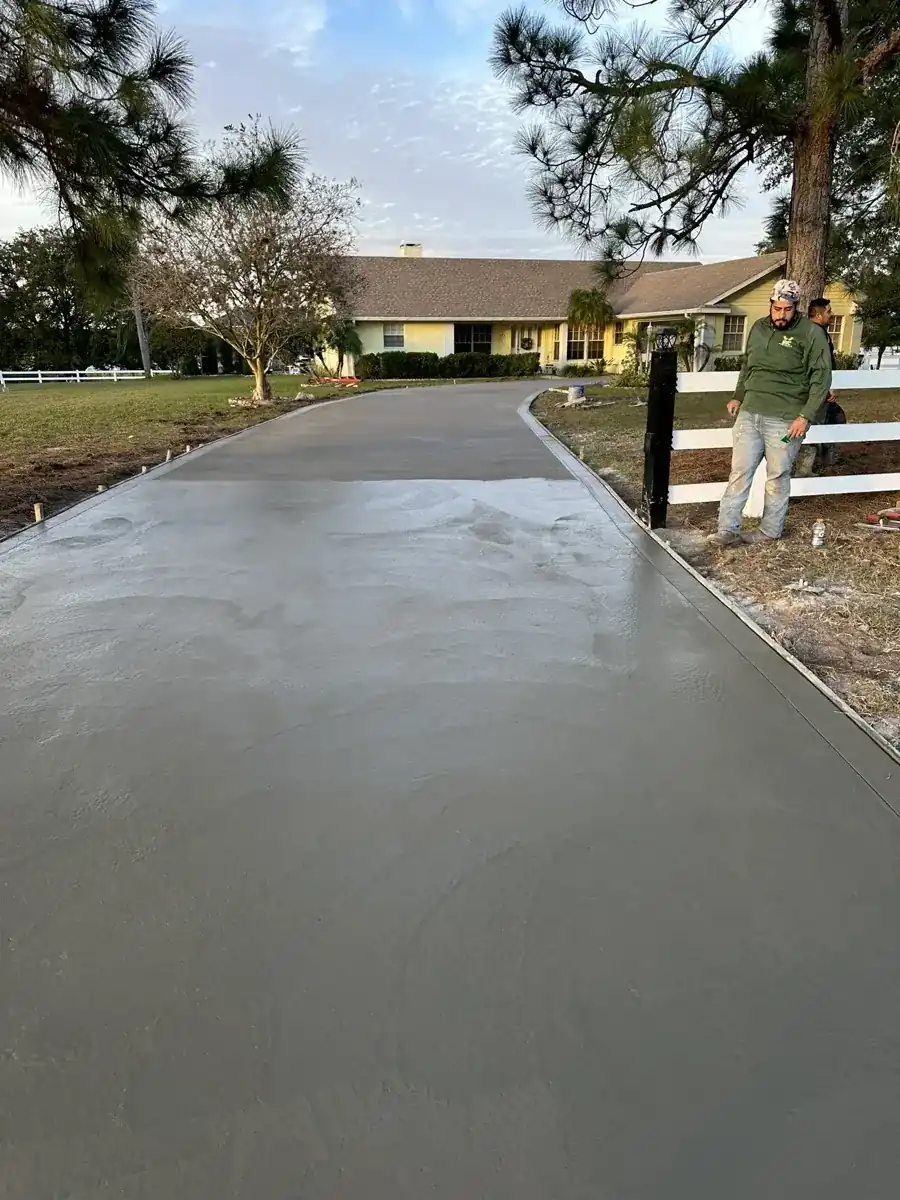
What It Costs
Our typical ranges for flatwork on big lots, before ITID or County fees.
| Job | Per sq ft | Typical project | What moves the price |
|---|---|---|---|
| Concrete driveways | $7 to $13 | $3,500 to $9,100 | 4 to 5 in. broom finish, typical 2-car, about 500 to 700 sq ft; tear-out adds $2 to $4 per sq ft; the part over an ITID culvert is thicker |
| Concrete slabs & foundations | $7 to $12 | $1,400 to $7,200 | 4 in. reinforced, shed pad to 2-car garage, about 200 to 600 sq ft; wet ground adds base and fill work |
ITID From Sketch to Final Inspection, Step by Step
ITID's driveway policy, adopted by its Board in October 2025, sets the sequence that decides when a truck can pour a driveway in The Acreage.
- Application and sketch. The permittee files through ITID's Civic Access system with a sketch placing the driveway centerline to the nearest tenth of a foot from an adjacent property line, plus the width and driveway type. The initial layout and inspection fee is $250.
- Call 811. Florida requires the excavator to notify Sunshine 811 at least two full business days before digging.
- Stakes. ITID places survey stakes in the swale within ten business days of the permit being issued.
- Swale and culvert. The permittee excavates the swale where it is needed, and the pipe goes in at the staked grades.
- Form board inspection. Before concrete goes over the culvert, the applicant calls the District office and schedules the layout and formwork inspection.
- Pour, then final inspection. ITID does its final inspection within five business days.
The permit expires 180 days after issue, and a renewal is $125. One re-inspection is free, and each extra layout or re-inspection is $125. A temporary driveway is $150. Ask every bidder who files the application and who books the form board visit, and get the answer in the written quote.
What Goes Over the Culvert: Six Inches, 4,000 psi and Four Inches of Sand
For a paved road with a 60 ft easement, ITID's concrete detail reads like a recipe: concrete at least 6 in. thick, rated 4,000 psi, over at least 4 in. of compacted sand, with at least 8 in. of cover above the culvert. The driveway is built from the road edge to the easement line, its surface has to match the road elevation, and the detail draws it 18 ft or 28 ft wide. The 8 in. cover tells you the pipe can't sit high, so the swale cut has to be deep enough for pipe, sand and a full slab to stack up without a hump at the road.
The pipe has its own rules: 15 in. diameter or as the District decides, smooth-interior HDPE or polypropylene rated H-20, or A-2000 PVC, with flared end sections. Headwalls, end posts and decorative walls are banned inside ITID easements, so the stone-faced entrance for a driveway in The Acreage has to live on your side of the line.
Stamped concrete and pavers in the easement are subject to removal, and the District won't put them back. When ITID retrofits a road or swale it may remove existing driveways and replaces permitted ones with 6 in. of compacted base rock, or with asphalt on a paved-road project, and the owner may redo concrete in kind at their own cost with ITID approval. That is why our stamped work on a driveway in The Acreage stops at the easement line.
How Far a Long Driveway Can Run and Where a New One Cannot Start
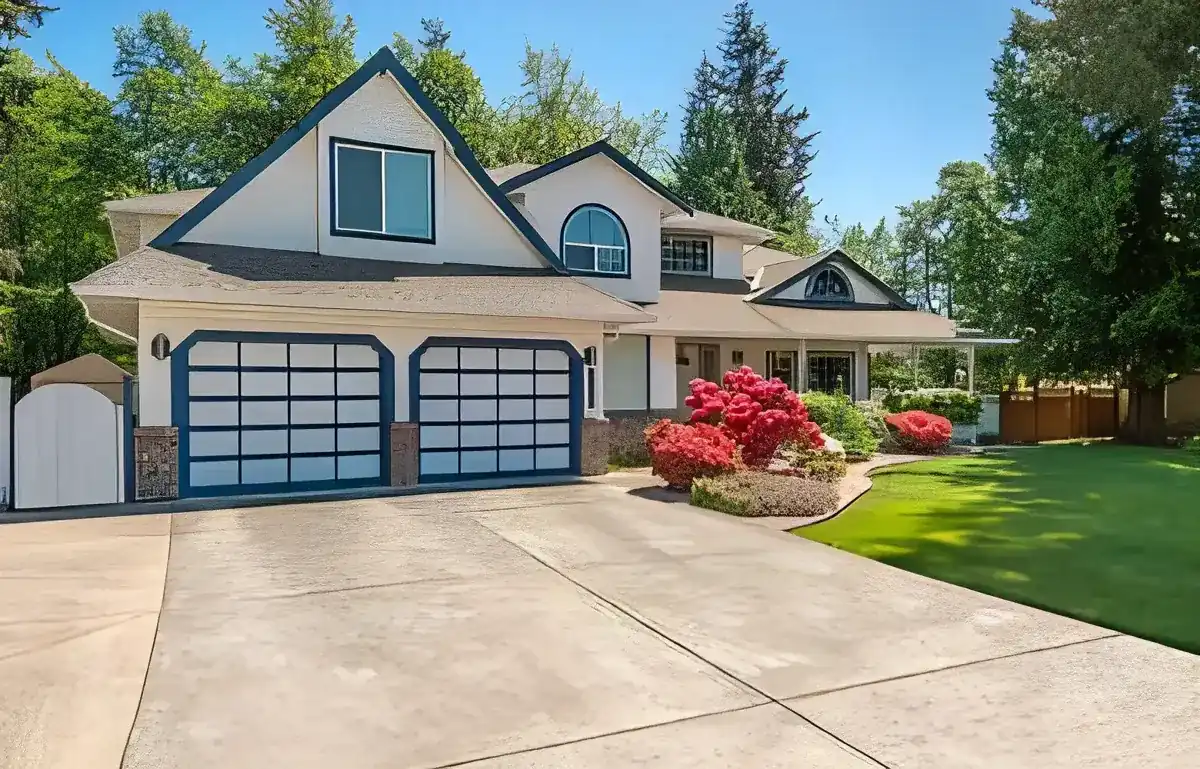
If you own an acre or more, you may want a long driveway in The Acreage, and the limits come from the pipe and the corners. The County allows a maximum of two driveways. ITID caps total culvert length at 80 ft and a single culvert at 40 ft on a lot with road frontage on one side, though a single driveway with a 60 ft culvert can be permitted with end treatments and a mid-pipe access structure the owner maintains. Driveway edges must sit at least 30 ft from District neighborhood roads, 50 ft from District major roads or County collectors, and 75 ft from County arterials.
New driveways are prohibited on 60th Street North between 180th Avenue North and Mandarin Boulevard, and next to traffic-calming devices. Before you tape out a driveway for the Acreage lots along Orange Boulevard, Persimmon Boulevard or Coconut Boulevard, find out which class of road fronts you.
Behind the easement line the concrete is on your lot and ITID's section no longer applies. We set the thickness and base for that stretch in the quote, at 4 to 5 in. with a broom finish, and cut a joint where the thicker section meets it. Our driveway cost guide shows how thickness moves the number.
Price Math for an Acre-Lot Driveway and a Shop Slab
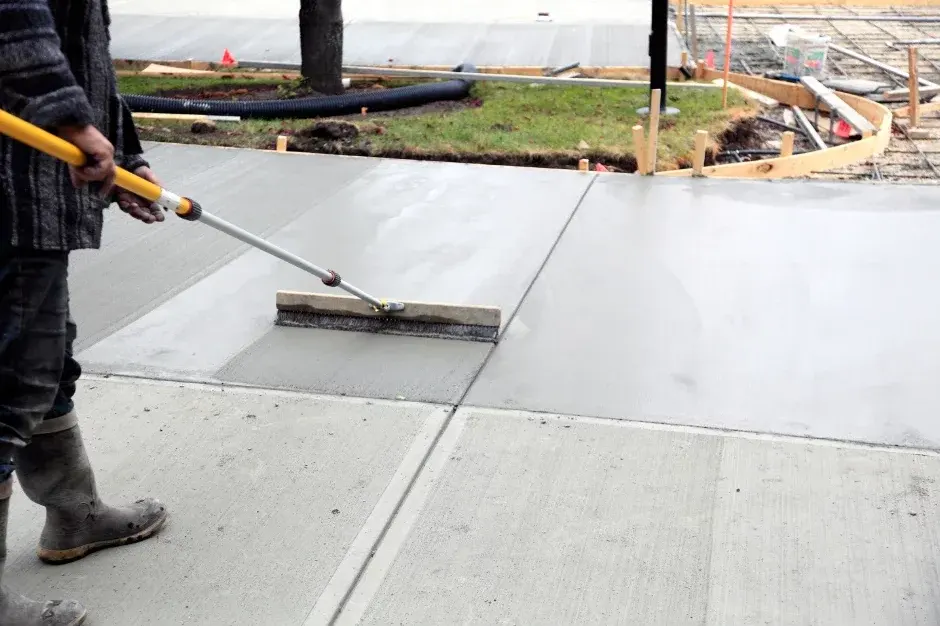
Our typical range for a concrete driveway in The Acreage or the Groves is $7 to $13 per sq ft, and for a slab or foundation it is $7 to $12. A driveway 18 ft wide and 120 ft long is 2,160 sq ft, so $15,120 to $28,080 at $7 to $13. A 30 by 40 shop slab is 1,200 sq ft, so $8,400 to $14,400 at $7 to $12. Those are broom-finish figures, with a free written estimate after we see the site.
Several items sit on top of the per-foot math. The 6 in. section over the culvert uses more concrete than a 4 in. run. The pipe, the swale cut and the base add labor, wet ground can call for more sand and fill, and a tear-out adds $2 to $4 per sq ft. Agency fees are separate: ITID's $250 layout fee, and the County turnout fee where a County road is involved. Where a County turnout needs a culvert, 40 ft of pipe at $35 per foot of culvert length is $1,400 on top of the $275 turnout fee.
The Town of Loxahatchee Groves: Portal Permits and a 3000 PSI Apron
Inside the Town, the Building Department issues the permit, and since January 13, 2025 permits are processed only through the MGO online portal. Inspections are booked Monday through Friday in the same portal with a 3 p.m. cut-off the day before. The Town's driveway checklist asks for a permit application, an owner-builder affidavit and Notice of Commencement if they apply, a New Construction Affidavit, a Hold Harmless form, consent from each utility with an easement, a marked-up survey showing the driveway work in square feet, a signed contract or invoice, and an installation detail.
The apron is where the Town gets particular. Right-of-way, apron and sidewalk concrete is replaced at a minimum of 3000 PSI, formed and inspected before anything is poured, and the apron flares out while holding a 2 ft setback from the property line. The form board inspection also checks drainage pitch. The Town's Right-of-Way Use Permit covers grading and paving in the swale and asks for the culvert size, type and invert elevations. Public Works stakes them within ten working days. The code sets no minimum width, a 24 ft maximum, and no driveway within 50 ft of a roadway intersection. Our page for concrete contractors in Loxahatchee Groves adds town-level detail.
Fifteen Inches of Pipe, One Entrance per Lot and the Rock-to-Concrete Switch
Every driveway connection in the Town needs a culvert of at least 15 in. under Section 70-025 of the land development code, in the same pipe types ITID accepts, with flared ends and no headwalls. The Town allows one driveway per property, and two on a lot of at least one acre; confirm the spacing with the Town before you draw a second entrance, because its code and its policy don't read the same. Canal maintenance roads aren't allowed driveways.
Replacement is where the paperwork gets tricky. The Town's driveway policy treats a like-for-like replacement in the same spot, with the minimum cover, differently from a new driveway, so check with the Building Department and Public Works before you assume which permit applies. Changing the type, such as from base rock to concrete or asphalt, needs a New Driveway Permit, and so do culvert replacements and extensions. Building permits cost $250 up to $7,500 of valuation, and a right-of-way permit obtained after the work costs four times the fee. Pavers and stamped concrete in a Town easement can be removed during road or swale work and are not replaced.
Swales, Sod and Graded Roads After the Pour
Every driveway in The Acreage crosses a swale, and both agencies treat it as a drainage structure, not a front yard. ITID allows only permitted driveways, sod and mailboxes in the swale easements, asks owners not to fill the swale or block culverts, and notes that swales take several days to weeks to drain. The Town says not to fill, grade, pave or alter swales without authorization. In the Town the sod must be Bahia, Floratam isn't permitted, and no irrigation goes in the right-of-way.
Graded roads are part of the job on both sides. ITID says it runs five graders and needs about two weeks to grade every road, and the Town posts a monthly grading schedule for its base rock roads. We look at the road surface, the culvert ends and the turning space for a ready-mix truck before we schedule a pour, and where a truck can't reach the back of a long lot the quote says how the concrete gets there.
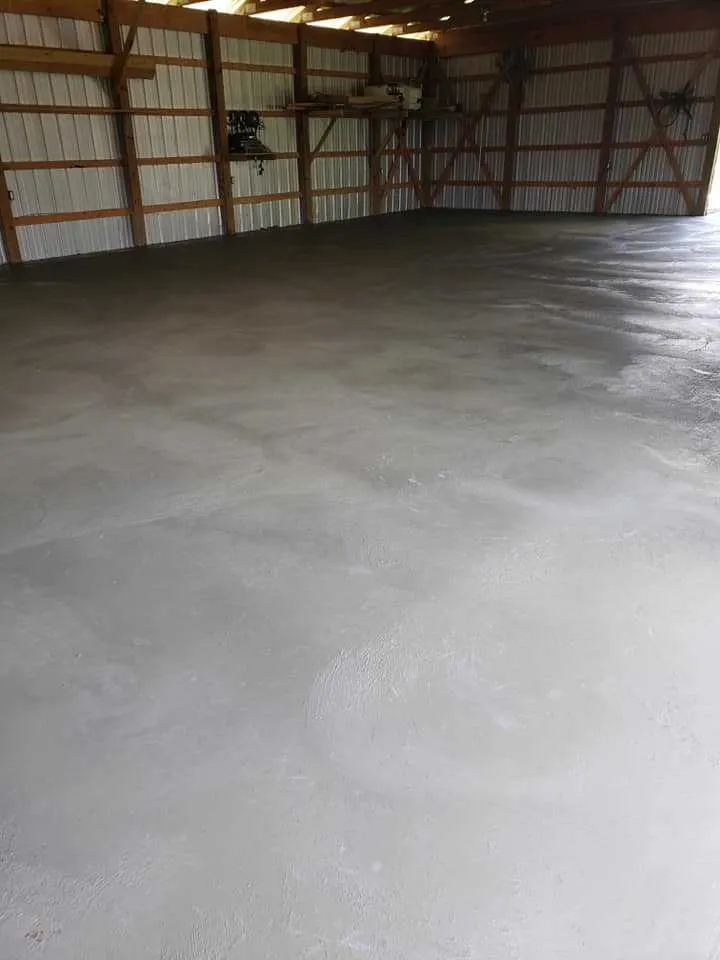
Wet Ground Under Shop Slabs, Barn Pads and Garage Floors
Federal NRCS soil maps at 30 points inside the Acreage boundary show 46.7 percent Riviera fine sand, 33.3 percent the depressional phase, where the water table can rise to the surface, 13.3 percent Boca fine sand and 6.7 percent Wabasso fine sand. All are poorly or very poorly drained, the Riviera water table can rise to about 6 in. below the surface at its highest, and every unit is rated "very limited" for dwellings without basements. In the Groves, Riviera fine sand was 73.3 percent of map points. These are shares of map points, not acreage. FEMA flood zones at the same points were Zone X at 93.3 percent and Zone AE at 6.7 percent in The Acreage, and 76.7 percent and 23.3 percent in the Groves.
Behind a long driveway in The Acreage, a shop or barn slab sits on the same ground, and wet ground puts the work under the surface. The residential code asks for a slab at least 3 1/2 in. thick on fill free of vegetation and compacted for even support, with clean sand or gravel fill capped at 24 in. unless approved. A vapor retarder is waived for driveways, flatwork and unheated accessory buildings, but a shop that will later be walled in and conditioned should get one. The ready-mix industry's guidance is to keep curing for at least three days, because hot sun and wind pull moisture out of fresh concrete.
Questions to Settle Before You Sign for a Driveway in The Acreage
Bring this list to any bid, ours included, before you pay a deposit on a driveway in The Acreage or the Groves.
- Which desk has my lot: the County and ITID, or the Town of Loxahatchee Groves?
- Who files the application, in whose name, and who books the form board inspection?
- What thickness, psi and sand base does the quote show over the culvert, and what does it show on my lot?
- How many feet of culvert, in what pipe, and does it fit the 40 ft and 80 ft caps?
- Where does the finish stop? Stamped or paver work stays inside my property line.
- How will trucks reach the pour on a graded road, and in how many loads?
Send your survey, a photo of the road edge and the size you have in mind through our free estimate page. We walk the lot, then put the spec, the price and the permits your parcel needs into one written quote.
Questions We Get
How do I tell which desk permits a driveway in The Acreage or the Groves?
Does the culvert cap limit how long a driveway in The Acreage can be?
Can I stamp or color the part of a driveway in The Acreage that sits in the easement?
What happens to my driveway in The Acreage if the District rebuilds my road?
What changes when I swap a base rock driveway for concrete in Loxahatchee Groves?
Is the ground under a shop slab in The Acreage really that wet?
What does a long driveway in The Acreage cost on an acre lot?
How long from application to final inspection for a driveway in The Acreage?
Sources we used
- Driveways, Indian Trail Improvement District
- Permits: Install a Driveway / Culvert, Indian Trail Improvement District
- FAQ's (Do's and Don'ts), Indian Trail Improvement District
- Permit Center, Palm Beach County PZB Building Division
- Residential Driveways, Palm Beach County Engineering, Land Development Division
- Driveway Full Application Package, Town of Loxahatchee Groves
- Subdivision Driveway Installation, Repair & Removal Policy, Town of Loxahatchee Groves
- HB 803 Public Memo - Building, Palm Beach County PZB